Showing posts with label Alaska State Library. Show all posts

Monday, April 20, 2020

Newly released: At the APK episodes!

One of the things we really miss during the coronavirus closure is public programming. In the four years since we opened the APK, we've developed a regular series of author and artist talks, presentations by historians, film screenings, and youth art activities that highlight the collections and exhibits of the Library, Archives, and Museum in interesting and entertaining ways.

Thanks to a partnership with 360 North, we've been able to capture many of those programs on video. Our new 360 North producer, Bethany Lowrance, has edited and posted the latest season of episodes. Here are a few of our favorites from the past year.

Kirk Johnson and Ray Troll on Cruisin' the Fossil Coastline

Kirk and Ray, the scientist and the artist behind last summer's Cruisin' the Fossil Coastline exhibit, obviously have a great time when they get together, and so did the audience. Kirk, a paleontologist and director of the Smithsonian National Museum of Natural History, packed a ton of science into his presentation, illustrated by Ray's quirky humor.

Emily L. Moore on Proud Raven, Panting Wolf: Carving Alaska's New Deal Totem Parks

This talk and the accompanying book tie in perfectly to the Library, Archives, and Museum. One chapter focuses on the Proud Raven totem pole, previously called the Lincoln pole, on exhibit in the Museum's Foreign Voyagers gallery. Dr. Moore also used archival records and historic photographs to document the creation of southeast Alaska's most iconic tourist destinations.

Alaska State Museum staff presentations

I never get tired of hearing my colleagues share their knowledge, and we were fortunate to have three of them talk about some of their favorite topics in the past year.

Steve Henrikson presents The Case for Tranquility Base
For the 50th anniversary of the moon landing, Curator of Collections Steve Henrikson recounts the saga of the Museum's missing moon rock, a real-life museum detective story complete with international intrigue, possible arson, and a top secret trip to NASA to retrieve "the football." The moon rock returned to Alaska and was one of the last exhibits in the old Museum before it closed in 2014.

Anjuli Grantham on Tin Can Country: Southeast Alaska's Historic Salmon Canneries
Curator of Museum Services Anjuli Grantham wears many hats, including historian and book editor. Along with contributing author and "fishtorian" Bob King, Anjuli talks about the role that salmon canneries played in Alaska history.

Andrew Washburn presents Illuminating Subjects: Snippets of Lighthouse History and Preservation in Alaska
Museum Registrar Andrew Washburn is both a museum professional and the Vice President of the Cape Decision Lighthouse Society. He combines these two roles in a presentation about the history of the lighthouse service in Alaska and the challenges and successes of groups preserving lighthouses around southeast.

The At the APK playlist includes other great episodes from previous seasons, including U.S. Poet Laureate Tracy K. Smith, Ken Coates on the Princess Sophia, Leland Hale on What Happened in Craig? and Tlingit master carver Wayne Price. A big thanks to 360 North for recording, editing, and posting these programs. Happy viewing!

Wednesday, November 28, 2018

Seeking an Electronic Resources Librarian

We're hiring for an Electronic Resources Librarian here at the Alaska State Library. This position will coordinate the Library's serials collection and other electronic resources. It is a full-time Librarian I, pays $4,355 monthly with state benefits, and is located at the new Father Andrew P. Kashevaroff State Library, Archives, and Museum in Juneau, Alaska. The job description and application information are available on Workplace Alaska.

The Alaska State Library, Archives, and Museum building in Juneau, Alaska, with the iconic Nimbus sculpture in front. Photo by Lara Swimmer.

Here are four reasons why you should apply for this position and consider moving to Juneau.

1. It's in Alaska. If you've ever wondered about living in Alaska, this could be your chance! Juneau is a great place for people who love kayaking, hiking, and the outdoors, and prefer cool temperatures and mild winters. If your image of Alaska is a frozen block of ice, think again. Juneau's weather is less extreme than most of the country. My friend in Washington, D.C. reported a colder Thanksgiving Day than we had here.

2. Juneau has a great library community. There are three branches of the Juneau Public Libraries, a university library at the University of Alaska Southeast, and the State of Alaska operates the law library, legislative library, and the Alaska State Library. No matter your library interest, there's a way to pursue it in Juneau.

Staff photo of the Alaska State Library, Archives, and Museum.
This position is based in the library, but you'll have a chance to work with people from special collections, archives, and museums.
3. Working here is a great way to explore the field. The Electronic Resources Librarian position is part of the Library's Information Services section, but that doesn't mean that the work is limited to state government needs. Since the Library shares a facility with the Alaska State Library Historical Collections, the Alaska State Archives, and the Alaska State Museum, this is a perfect place for an information professional interested in history or heritage work to get a wide variety of experiences.

The Reading Room of the Alaska State Library
The Library's Reading Room gets beautiful natural light thanks to the clerestory windows that circle the building.
4. You'll love coming to work. Our building opened in 2016 and we still can't get over how lucky we are to work in this beautiful space. Our office windows overlook Gastineau Channel and Douglas Island and you can see mountain goats on Mount Juneau from our break room. Many coworkers enjoy walking to the shops downtown or along the new seawalk to the whale park on their lunch breaks. We have dedicated parking and indoor racks for bikes.

The recruitment closes on Monday, December 3, at 5 pm Alaska time. Come join our team as our next Electronic Resources Librarian!

Thursday, October 18, 2018

Guest post: Sara Bornstein on dispelling the mysteries of the Research Center

Today's guest post is from Sara Bornstein, Librarian I with the Alaska State Library Historical Collections. Thanks to Sara for introducing readers to the Research Center. - Claire


The Alaska State Archives and Historical Collections Research Center is open to everyone.
“Can I come in here?”
This is a question I got at the Historical Collections reference desk the other day, and unfortunately it’s not the first time. The answer is yes, please do! All we ask is that you leave your food and beverages at the door, stow your pens, and no you won’t be able to check out material to take home.

Perhaps the numerous rules are part of the reason patrons worry about stepping foot in a special collections library. Let me first explain some of the guidelines of the Research Center. A better understanding may make the library less daunting. Then I’ll tell you how you can start your research at home so you’ll be prepared when you walk in the door the first time.

The first thing you’ll notice when arriving at the Research Center is the lack of bookshelves and readily available research material. This is because our overall aim is to save the material you’d like to see for generations to come. In order to do this, we keep everything not currently being used stored in a cold, temperature-controlled environment. This slows the process of inevitable decomposition. Secondly, we ask you the patron to aid in these efforts by abiding by the strangely strict Research Center Guidelines. While you may believe yourself to be a careful person, accidents do happen and we’d rather prevent the possibility of food and drink spilling on irreplaceable material. And as for the no pens, ink can transfer or pens can slip. Believe me, I’ve done it- and I’m a librarian. And the last thing we ask, to prevent the accidental shuffle of rare material into your papers, is that bags and packs are put in the provided cabinets in the library.
Using Folder Out markers help keep collections in order and pencils prevent accidental ink transfer.

So what do you allow in the library then?
We definitely want you to be able to take notes and record your findings since you can’t take material home. You can take notes with a pencil and paper. You can take photographs with a camera or phone. Just leave the flash off- light can fade paper and photographs real quick. We even provide scanners in the Research Center so if you have a flash drive with you it’s no extra charge to make digital images for later reference.

Ok, but you said I could start research at home?
While we love when you come visit us in person, we also like to find ways to decrease the physical use of original material if we can. The less handling, the longer it will last. This has led us to make digital copies of some of the material held at the library and some of these surrogates are available online.

The Alaska Digital Archives: Photographs, Manuscripts & Maps
Photographs, documents, and maps that have been digitized are available on the Alaska Digital Archives (http://vilda.alaska.edu/). As a bonus, there are several repositories around the state that add material to the Digital Archives so you won’t be limited to just the State Library & Archives collections.

Chronicling America: Pre-1923 Newspapers
If you’re looking for information that might be in a pre-1923 newspaper, the National Digital Newspaper Program is making word-searchable newspapers available through the Library of Congress on a site called Chronicling America (https://chroniclingamerica.loc.gov/). To read more about the Alaska Digital Newspaper Program check out the website (https://library.alaska.gov/hist/newspaper/digital_home.html). For later papers you’ll still have to visit the library’s microfilm collection.

The Alaska State Library shares a catalog with other libraries from around the state.

The Alaska State Library Catalog: Books & Special Collections
If you don’t find what you’re looking for on the Alaska Digital Archives or Chronicling America, I suggest you next check the Alaska State Library Catalog (https://jlc-web.uaa.alaska.edu/client/en_US/asl/). This catalog is also made up of records from several libraries around the state so if your local library doesn’t have a book you’d like, you may be able to Inter-Library-Loan it from another library. The Historical Collections’ photograph and manuscript collections can also be searched through the catalog, however, because you can’t check them out, what you’ll find in the record is slightly different than that of a book. At the bottom of the record you’ll find a link that says “Finding Aid”. Open this and you’ll find an inventory list of what’s in the collection and a little more history about the material. These documents are also word searchable, so you may even be able to narrow down what you’re looking for to a specific box, folder, or item. Once you’ve determined there is something you’d like to see in the collection, either visit us in person so we can pull the material from storage for you, or contact us and find out if there’s another way for you to view the material.
These should be enough resources to get you started. If you’re looking for more, there are several good posts in the archives of this blog, or available on our websites (which can be found on the sidebar).

I hope I’ve dispelled some of the mysteries of the Research Center, and can’t wait for you to visit!

Wednesday, June 27, 2018

Exploring the Arts at the APK

The Exploring the Arts youth activity program is one of our most popular offerings here at the Alaska State Library, Archives, and Museum, and it is made possible by the Friends of the Alaska State Library, Archives, and Museum and a grant from the City and Borough of Juneau. This past year, we offered 13 workshops to 356 Juneau youth with Alaskan artists from around the state. We made books, sculpted clay, constructed collages, drew dog portraits, painted landscapes, decorated masks, made hats, and learned about Alaska.

In October, local author Susi Gregg Fowler and illustrator Jim Fowler led an Alaska book workshop. Participants learned about crafting a narrative and sketching from life. They saw how the Fowlers incorporate elements from their own lives into their stories and pictures and saw Alaska represented in their books. Then they created their own books, working in the Library and Archives' Research Center, surrounded by Alaska historical materials.
Jim and Susi Gregg Fowler signing books.
Jim and Susi signing their most recent book, Arctic Aesop's Fables. Photo courtesy of Susi Gregg Fowler.
Participants hard at work on their original stories and illustrations.

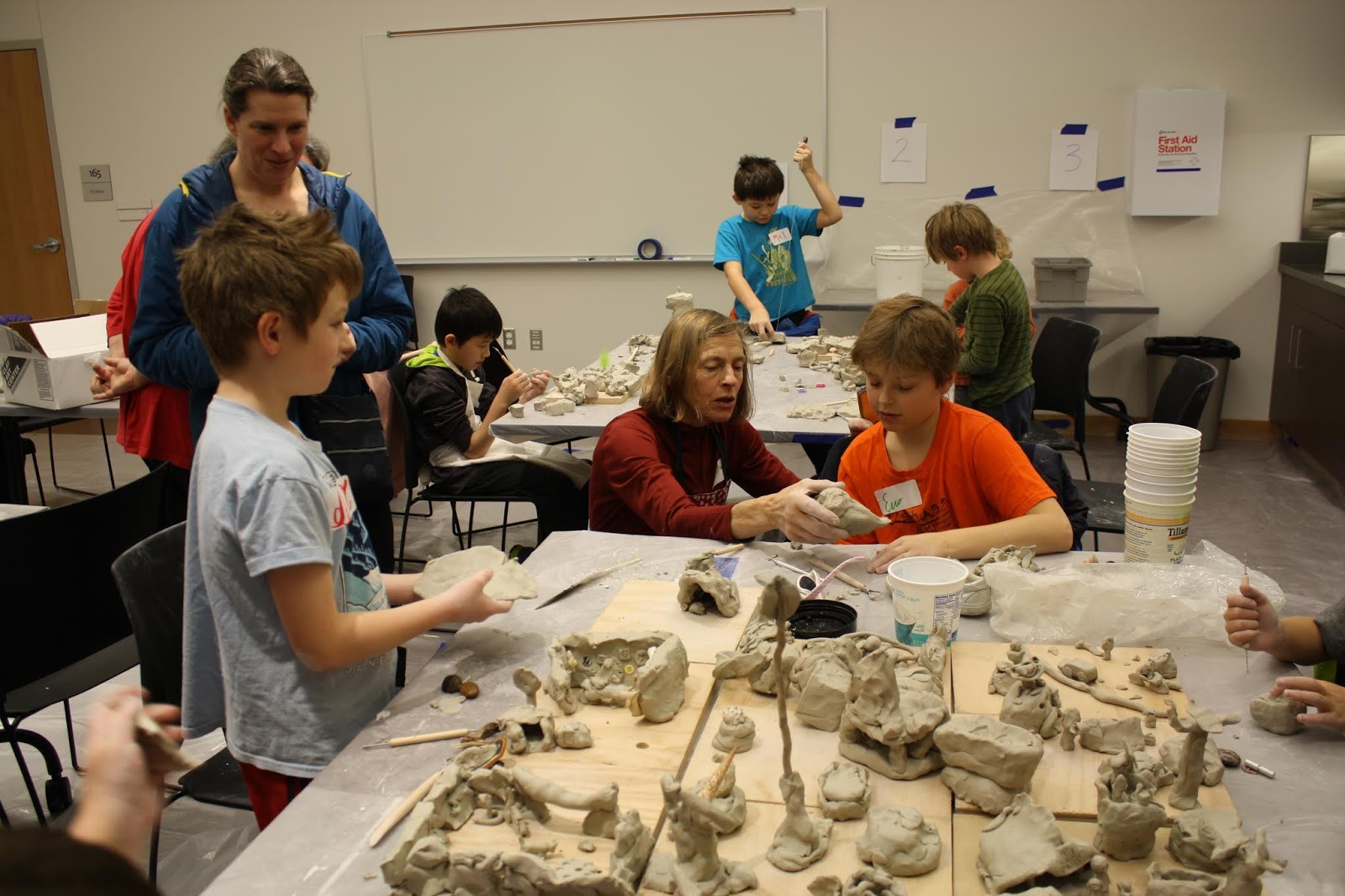
In November, two of the Alaska State Museum's 2017-2019 Solo Artist exhibitions opened at the Museum, and the artists each led a workshop for kids. Annette Bellamy, a large-scale sculptor from Halibut Cove, toured the kids through her exhibit Moving Mountains and then taught them clay sculpting techniques. Participants created their own clay sculptures, incorporating found objects they brought from home, and worked together to create a clay village that included a museum, a Walmart, houses, and a giant lizard (all the elements of a thriving village).
Annette and the kids circle her kinetic sculpture, the centerpiece of the Moving Mountains exhibit.
The collaborative village included a museum with natural history specimens, artwork, and a visitor contemplating the exhibits.
 
Daniel Papke of Skagway shared his exhibit, Lost Language, a series of oil paintings that told the story of a young woman on a journey to find her ancestral language. Then he led participants in creating layered artworks that incorporated collage and painting to introduce motifs and visual story elements. Each participant practiced storytelling techniques by sharing their painted collage and the accompanying story with the group.
Daniel shared some tips that he uses in his paintings when developing a visual story.
A participant shares his story about a man in a yellow hat who travels the world until he finds a new, purple hat.

Early January was winter break for Juneau kids, so we held a Fun with the Family Fair at the APK. Check out our previous post for a detailed report about the fair.

In February, local artist Nobu Koch led a dog portrait drawing activity. Kids loved looking at photos of dogs from our Historical Collections and each other's family dog photos, and then creating their own portraits. We even had live dog models who posed for some quick sketching exercises.
Debbie, our administrative officer, brought in her dog, Nikita, to model for the kids.
A participant shares her portrait of her dog, Pepper, playing outside in a field on a sunny day.

In March, Anchorage painter Linda Infante Lyons opened her exhibit, Ebb and Flow, and led kids in creating landscape paintings. They learned about creating distance using color and value and painted volcanoes and island scenes.
Touring Ebb and Flow with Linda.
Adding small trees to the island landscape.

In April, arts educator Daniel Todd taught kids about the history of masks in cultures around the world. They practiced artistic techniques of sketching and designing their masks and then implementing those designs on papier-mache mask bases using paint, feathers, beads, and other found objects.
Dan demonstrates a sketching technique. The kids around him have their mask bases ready for decoration.
Two participants show off their masks.
These masks incorporated feathers, beads, ears, and other interesting appendages.


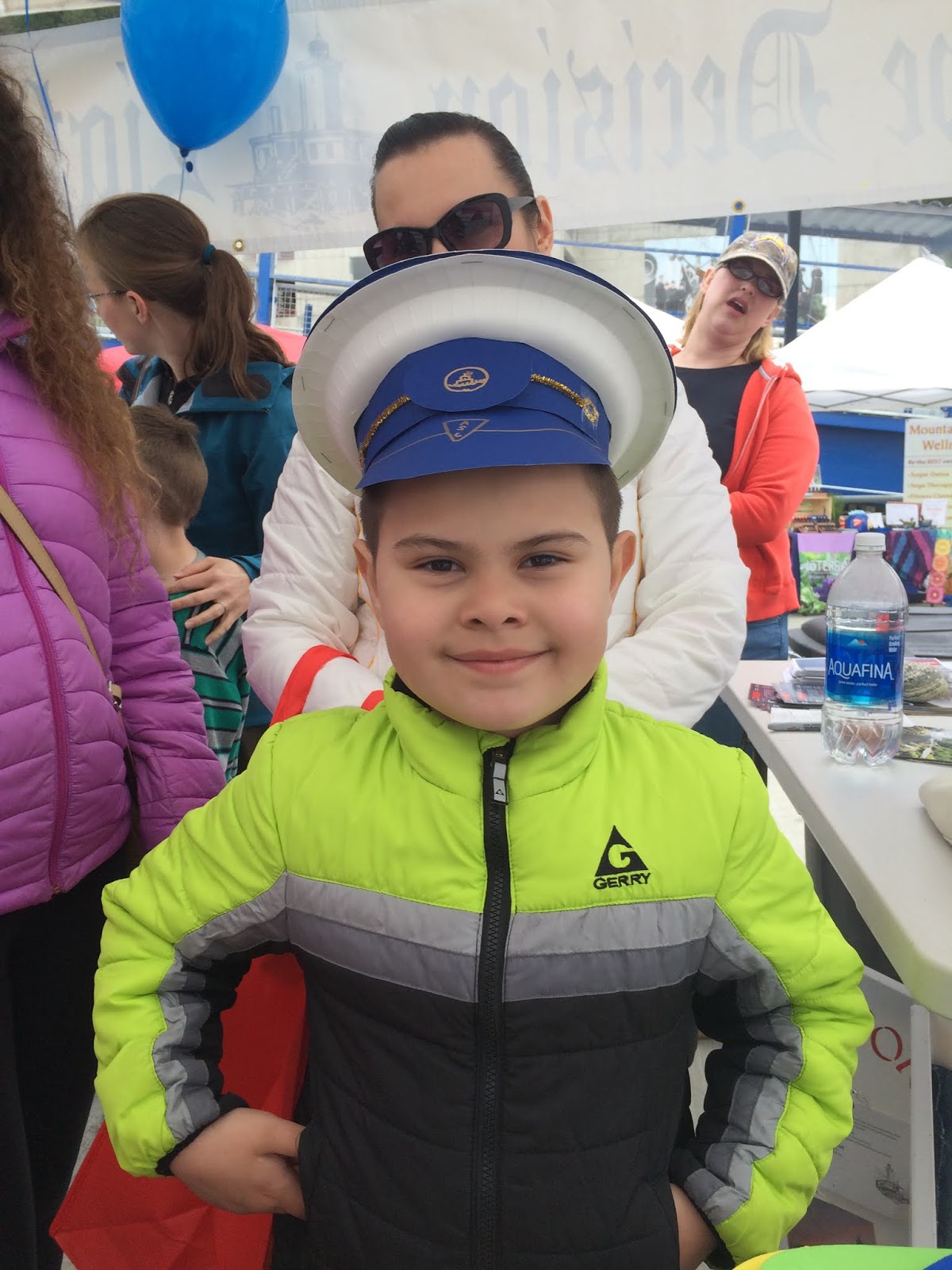
In May, we hit the high seas and took the youth activity program to Maritime Fest. We made Alaska Steamship Company captain's hats, Unangan-inspired visors, and sugar cube lighthouses with our community partner, the Cape Decision Lighthouse Society.
A jaunty captain and his siblings making sugar cube lighthouses at Maritime Fest.
A boy wearing a completed captain's hat made out of paper plates, blue cardstock, and gold decorations.
The captain's hats were a big hit. One Coast Guard captain said that he saluted every young captain who went by.

We love the youth activity program here at the APK and are excited to announce that the Friends have received a grant for FY19 to continue the program. We look forward to bringing you more fun art opportunities for kids starting in October 2018! To get notifications about these workshops, visit Youth Art Activities at the APK and sign up to receive e-announcements.

These programs are partially funded by the citizens of the City and Borough of Juneau through sales tax revenues and are sponsored by the Friends of the Alaska State Library, Archives, and Museum.

Thursday, June 14, 2018

Connecting Alaska through the Alaska Library Consortium

Last month, Fairbanks area libraries joined the Alaska Library Consortium, meaning that 92% of Alaskans can freely and easily share 3.2 million titles through one library catalog. For us, the addition of UAF Rasmuson Library is particularly exciting, since Rasmuson has an excellent Alaska collection, especially for materials about the interior and Arctic regions.

Each library in the Alaska Library Catalog has its own configuration. Although the materials are the same, using your home library's catalog has certain benefits. One is that your library will appear at the top of the locations list.
Alaska Library catalog record for Walter Harper: Alaska Native Son by Mary Ehrlander.
Many libraries in the catalog have this book, Walter Harper: Alaska Native Son. Although there's one at the State Library, it's in Historical, so it's only available for in-library use. To check it out, you need to request it from another library.

To request this book from another library, click on "Place Hold" on the right, enter your library card number and PIN, and designate your pickup library. Then one of the libraries will find it on their shelves, package it up, and mail it to your local library for you to pick up. When it arrives, you'll get a phone call or email depending on how your account is set up. If you don't know your PIN, you can ask your favorite librarian to look it up.

If you're impatient and don't want to wait for an item to be mailed, you can limit search results to local results only. The catalog knows that there are three systems in Juneau, the State Library, Juneau Public Libraries, and UAS Egan Library (Sealaska Heritage Institute is also included, but their books cannot be checked out). The Juneau area libraries use a courier to transport items between libraries and it usually takes just one or two days for a Juneau item to be delivered.
The collections dropdown menu on the Alaska State Library's catalog page.
Selecting Juneau area libraries means you can see what's available in your area. You can also limit the results to your library, or Alaska Digital Library for e-books and audiobooks.

Want a little help navigating the Alaska library catalog? Visit your library and ask for a quick tutorial. We're happy to help you borrow more books, DVDs, audiobooks, and music than ever! The joint catalog also means that if you're traveling, you can use your local library card at any of the libraries in the consortium, and you can return your books or DVDs to any of the 87 libraries.

Tuesday, April 24, 2018

New hours for the Alaska State Library and Alaska State Archives

We're pleased to announce that the Richard Foster Reading Room of the Alaska State Library and the Research Center of the Historical Collections and Alaska State Archives will be open Mondays beginning on April 30, 2018. New hours are Monday through Friday from 10 am to 4 pm. The Library and Archives have been closed to the public on Mondays since September 2016, but recent additions to the staff have made it possible to restore Monday hours.
The Alaska State Library Reading Room.
Visitors can soon enjoy the Reading Room and access Library resources Monday through Friday. Photo by Lara Swimmer.

If you're working on a historical research project and even these increased hours do not work for you, or if you'll only be in Juneau on a Saturday this summer, the Library can offer a limited number of Saturday research appointments. Although we cannot guarantee that every request will be granted, we'll try our best to accommodate you. Find contact information in the LAM directory..

How does research at the Library and Archives work?

The materials in the Reading Room, including Alaska newspapers on microfilm, and in-library databases are readily available whenever the Library is open. Items from the Historical Collections and the Alaska State Archives are stored in climate-controlled secure storage and brought into the Research Center for viewing.
The interior of the Alaska State Library and Archives vault, showing tall rolling stacks with ledgers and records boxes.
Wayne pulls records boxes for researchers at the Alaska State Archives. Photo by Chris Arend.

You can search the Historical Collections through the Alaska Library Catalog or peruse a list of photograph and manuscript collections. A selection of photos, videos, and manuscripts are also available on Alaska's Digital Archives. The image below is a record from the Alaska Library Catalog for a VHS tape about the Treadwell Mine. In order to watch this video, write down the call number and come to the Research Center. A staff member will retrieve the item from the vault and wheel in a television and VCR for you to use. The same process is used for books, photograph collections, journals, and nearly all other materials.
Catalog record for video The Treadwell Mine.
Click on this image to see the record larger.

Records from the Archives are organized a little differently. Most of the records are arranged according to the agency that created them, like the Department of Fish & Game or the Office of the Governor, and then subdivided in various ways. Because each item is not individually described, researching at the Archives means flipping through a lot of folders and methodically going through boxes. Although it's less precise than searching the Library catalog, looking through records usually provides interesting context and research rabbit holes.

When you find something of interest, there are scanners and a photocopier for use in the Research Center. Copies are 10 cents a page and scans are free. You may bring your own USB drive or purchase one from the Library.

If you have a specific research topic or if there are many items that you'd like to look at, it's best to contact the Historical Collections or Archives in advance so that your requested materials can be retrieved and ready for you when you arrive. Working with a librarian or archivist before your visit usually results in a richer, more productive research session because he or she can help identify additional materials that may interest you.

What are the rules in the Research Center?

The Research Center has three main rules of which researchers should be aware. The first is that food and drinks, including water, are not allowed, to protect collections from pests and damage. The second is that bags need to be kept in lockers in the Reading Room or behind the Research Center desk. Third, pens are prohibited to minimize the risk of transferring inks to collections. Pencils are provided.

Research Center of the Alaska State Library Historical Collections and Alaska State Archives.
The Research Center is open to everyone and is staffed by experts from the Historical Collections and Archives.

If you'd like a more relaxed research experience, covered drinks and pens are allowed in the Reading Room, and the study tables have task lights and outlets to charge your devices. We look forward to assisting with your research!

Wednesday, January 17, 2018

What's happening at the APK?

There's a lot going on here at the Father Andrew P. Kashevaroff (APK) State Library, Archives, and Museum, and it can be hard to keep up with events, exhibits, and special opportunities. Fortunately, you have a lot of options for how to stay informed and can select the one that works for you.

In Your Inbox
At the APK & SJM newsletter
A monthly e-mail newsletter that comes out around the middle of each month, so January's came out in mid-December and February's will come out in mid-January. If you just want a minimalist listing of events coming up, this is the one for you.

Exhibits and Events listserv
Receive digital postcards for events in your inbox. These usually go out a week or two before the event and include exhibit openings, youth art activities, and other LAM-sponsored events. I like these because they have images and information about individual events as they approach.

Press Releases
You can receive notifications when new press releases are posted by entering your email and subscribing on the press releases page. Press releases include upcoming events, hours changes, artist calls for entry, public meetings, and other announcements. They usually have more background information than other formats.

New at State Library listserv
A very low-frequency list aimed at state employees who want to know about training opportunities, events, and new resources to help them do their jobs. We usually limit event notices on this list to ones that are available statewide through videoconferencing.

On the Web or On the Air
KINY Capital Chat
We have a monthly slot on KINY's Capital Chat where we run down what's coming up at the APK. It's usually on the last Tuesday of the month, but the schedule may vary. If you miss it on the air, you can find it on demand at KINY's Capital Chat.

KTOO Juneau Afternoon
Our presenters are frequently guests on Juneau Afternoon shortly before an event. This may include solo artists before their exhibit openings, authors giving book lectures, or occasionally one of our staff.

APK Calendar
A basic calendar that lists upcoming events. There is not a way to receive notifications when new items are added, but it's a place to check if you want to see what's coming up.

Through Social Media
If social media is your method of choice, you've got options.

Facebook
The Library and Archives' Facebook account posts the most consistently and includes all events sponsored by the Library, Archives, and Museum as well as the Friends of the Alaska State Library, Archives, and Museum. The Museum's business account is usually limited to museum events.

Twitter
Library & Archives: @AKStateLibrary
Museum: @AlaskaStateMuse

Instagram
Although not usually used for event notifications, our Division has two Instagram accounts.
Museum: @alaskastatemuseum
Alaska Digital Newspaper Project: @alaskahistoricalnewspapers

Other
We also post to the JAHC's Community Calendar and often our events are picked up by the Juneau Empire or Capital City Weekly.

Not sure if an event is happening in our building? Sometimes other organizations host public events in our building that we're not associated with, so not everything gets listed or posted. But if you give us a call, we can often find the details. All of our contact info is available on the LAM website..

Tuesday, January 9, 2018

Fun times at the Fun with the Family Fair

Last week, we hosted the first ever Library, Archives, and Museum joint family day, the Fun with the Family Fair. Since we moved into our new building, the Father Andrew P. Kashevaroff State Library, Archives, and Museum, we've been trying to find ways to better collaborate with each other and to share our collections with Alaskans.

The Friends of the Alaska State Library, Archives, and Museum apply annually for a youth activity grant through the City and Borough of Juneau's Youth Activities program. This grant supports free opportunities for young people to learn artistic techniques from professional working artists and to connect with the exhibits and collections of the Library, Archives, and Museum.
Kids at the workshop with Daniel.
Solo Artist Daniel Papke led a collage painting workshop in November 2017. Here, participants share their creations and their funniest faces.

The family fair was an extension of that program, but unlike most of the workshops, was completely homegrown. Our Division Operations Manager Lisa Golisek worked with doll artist Mary Ellen Frank to create chenille stem people, sled dogs, as well as kuspuks, robes, parkas, and accessories inspired by Alaska Native regalia and outerwear. This activity is a perennial favorite and frequently requested by our youth activity participants and parents.
              Volunteer Anne Fuller helps participants create chenille stem sled dogs.             
Sandy Johnston, Historical Library Assistant II, helps a young man create a chenille stem person.
Jackie Manning, Museum Curator of Exhibits, demonstrates how to make a kuspuk for the chenille stem figures.

Archivist Leah Geibel created a design your own flag activity based on the territorial flag competition in 1927, when 13-year old Benny Benson designed the eight stars of gold. A basic flag template, some submissions from the competition, and a few boxes of crayons were all that were needed for this station. It was great to have an activity appropriate for very young children.
Leah shows some samples from the territorial flag competition to some young flag designers.

Our Historical Collections has a great collection of early 3-D photo cards called stereograms or stereographs. These souvenir cards had two images taken from slightly different angles so that they create a 3-D effect when viewed with a stereogram viewer, and often featured stories or information on the back. Library Assistant Jacki Swearingen has worked extensively with the stereogram collection, even transforming some of them into anaglyphs, 3-D images viewed with red-blue glasses. She shared a selection of her favorites from the collection, many of which are more than 100 years old.
This is one of many stereogram cards from our collection. It shows President and Mrs. Harding visiting Metlakatla in 1923. Alaska State Library, PCA 418-22.

Kids created their own stereograms by setting up a diorama and then taking two pictures of the scene with a digital camera. These photos were then imported into Photoshop, dropped into a template with the arches, slightly edited by our volunteer Photoshop master Carl Brodersen, then printed. These were then cut out, glued onto cards, and tested out on the stereoviewer. We were amazed that they worked every time!
After the scenes were set up, the photos were taken, formatted, and printed, kids created their own stereogram card. These two even wrote stories for the reverse side.

Newspapers are a big part of our collections, and Technical Services Librarian Ginny Jacobs helped kids find the newspaper from the day they were born. We also had a newspaper printing station where kids could create their own paper using newsprint and rubber stamps. That turned out to be the messiest station!
Ginny looks over the newspaper production area after showing kids the newspaper from their birthdays.

Historic salmon can labels from the Alaskan canning industry are one thing that is held in all of our collections. Museum Registrar Andrew Washburn created templates and led children in an exploration of marketing and graphic design techniques. They even got to take their designs home on their own cans.
          Andrew offers options to participants ready to affix their labels to their cans.         

One station that was unexpectedly popular was a create-your-own-activity, which we stocked with magazines, glue sticks, colored paper, scissors, and crayons. Kids let their imaginations run free and came up with their own works of art.

Thanks to everyone who came by on their last day of winter break to spend the afternoon with us at the family fair! We had such a fun day with all of you. To find out about our next youth activity, visit our youth art activity web page.

The youth activity program at the APK is sponsored by the Friends of the Alaska State Library, Archives, and Museum and is partially funded by the citizens of the City and Borough of Juneau through sales tax revenues.

Wednesday, December 6, 2017

Using Alaska newspapers for research

A few months ago, Alaska's National Digital Newspaper Project Coordinator Leah Geibel wrote us a guest post about the first batch going online. Now that we've had a chance to explore the site a little more, we're very excited to put it to use.

The Alaska State Library has one of the most complete collections of Alaska newspapers on microfilm, and they are fantastic primary resources that document the lives of 19th, 20th, and 21st century Alaskans. However, anyone who's tried it will tell you that searching through microfilm is a long and tedious process. Librarians and historians in the past have done great work creating indexes to make the newspaper collection accessible, and we continue to use those resources nearly every day. Betty Miller's incredible five-volume masterpiece, Vital Records from Alaska Daily Empire 1916-1936, is a lifesaver for researchers. But what if you're less interested in the birth, death, and marriage information and want more day-to-day articles?

Mickey and Issie Goldstein eating lunch on ice at Auk [sic] Lake 1916. Alaska State Library Historical Collections, PCA 329-30.
That's where the digitized newspapers on Chronicling America can help. We recently looked into the life of former Juneau mayor Isadore Goldstein. There was a brief entry in Biographies of Alaska-Yukon Pioneers and our Historical Collections had a slim biography file on him. There were also a few pictures of him on the Alaska Digital Archives, which is certainly more than you'd find in your average genealogy search. But searching the Alaska newspapers on Chronicling America provides 100 results that shed more light on Mr. Goldstein's life as a young man and on Juneau's history.

Isa Goldstein returned with the launch Grace E. last night from a hunting expedition. He was hunting furs and was very successful, too. somebody killed two big grizzly bear, because Isa brought the skins home. Two of these skins are enormous in size, one is at least 11 feet long. They are both beautiful specimens.
This short article about Goldstein's grizzly bear hunt is from the Alaska Daily Empire from June 17, 1913.
Friends of Isadore Goldstein have nicknamed him "Willie Burns." Isa had an experience this morning of which he is saying but little. Doc Hamberg, who aided and abetted Mr. Goldstein, also has but little to say about it. Both of the sleuths feel that enough has been said already. At any rate, it happened thus: At 3 o'clock this morning Mr. Goldstein heard someone try to enter the Fairbanks restaurant, located opposite his apartments, over the Goldstein store, in Front Street. Isa seized his trusty gatling gun and warped across the street. He saw a man tinkering with the cash register in the restaurant, and after examining the gun to see if it were properly loaded, waited for his quarry. Finally the burglar came out. "Stick up your dukes," Goldstein commanded, and up went the bad man's mitts. "Say you big tramp, I'm one of the proprietors of this restaurant," the man explained, hands aloft. "I forgot the cash in the register when we closed up last night, and it worried me, so I came down to get it." Down went the gun, and down came the hands. Mr. Goldstein meanwhile instructed Hamberg, his room-mate, to phone the police. The bluecoats were not needed, however. The most unkind incident in connection with the capture, according to Mr. Goldstein, was the accusation, by the restaurant man, that Mr. Goldstein "must have been intoxicated."
On August 13, 1915, the Alaska Daily Empire described Goldstein's late-night attempt to prevent a "robbery."

Eagle-eyed readers may have noticed that sometimes Mr. Goldstein's first name is abbreviated to Isa. To capture both variants, you can use Chronicling America's Advanced Search features. You can also search phrases or for terms within 5-100 words from each other.
Screenshot of the Chronicling America search interface.
Entering "Isa Isadore" in the first box and "Goldstein" in the second box brings up results with (Isa OR Isadore) AND Goldstein.

Chronicling America features a selection of Alaska newspapers published before 1923, an interesting time in Alaska's history. It includes the gold rush, the Alaska Organic Acts, World War I, and the sinking of the Princess Sophia. We look forward to more pages and more titles being added as the project continues.

For more information about Alaska's National Digital Newspaper Program, visit our historical newspapers site, or follow the project's blog or Instagram at @alaskahistoricalnewspapers.

Thursday, November 30, 2017

At the APK makes its television debut!

We're excited to announce our new television series, At the APK, created in partnership with KTOO-TV and 360 North. The series showcases events that take place in our building, the Father Andrew P. Kashevaroff (APK) State Library, Archives, and Museum that relate to art, history, culture, literature, and education in Alaska. We are always looking for ways to reach out around the state and are thrilled about this opportunity to share our programs statewide through public access television. It also means that if you miss one of these events in our building, you'll be able to catch it on air or online at the At the APK page on 360 North..
Screenshot of the site for the At the APK program.
It's exciting to watch the At the APK page grow as more episodes are added.

We are currently making the first "season" of the show, which premiered on Alaska Day with Alaska State Writer Laureate Ernestine Saankaláxt’ Hayes presenting What Shall We Do With Our Heroes? Subsequent episodes air Thursdays at 8 pm on 360 North and include artist talks with carver and visual artist Jackson Polys, photographer Ben Huff, sculptor Annette Bellamy, Nimbus creator Robert Murray, and painter Daniel Papke. Authors are also represented by poet Joan Naviyuk Kane, novelist Don Rearden, playwright Vera Starbard, and Janet Collins, whose recent book On the Arctic Frontier tells the story of Arctic scientist and surveyor Ernest Leffingwell.

The KTOO team has been so much fun to work with and up for anything we want to try. When Annette Bellamy, one of the Alaska State Museum's 2017-2019 Solo Artists, wanted to lead an exhibit tour of her ceramic show Moving Mountains, the KTOO crew brought over cameras on pedestals and leapfrogged Annette and an audience of more than 50 people to beautifully capture her words and her monumental work. They've also helped us get the control booth in our lecture hall broadcast-ready and have mentored our staff in sound, lighting, and filming.

Still from the video of Annette Bellamy's gallery walkthrough of her exhibit, Moving Mountains.
Video of Moving Mountains, the featured piece in Annette's exhibit, captured its scale and movement better than a still image could.

This partnership has helped all of us think bigger about what we can do in our new building and how we can better share programs around the state and the world! Thanks to KTOO and to our former deputy director Bob Banghart for making this collaboration a reality.

Monday, November 6, 2017

Guest post: Damon Stuebner on the film Report from the Aleutians

On Friday, November 10, the APK will host three showings of the award-winning World War II film Report from the Aleutians by filmmaker John Huston at 1, 2, and 3 pm. LAM film and video specialist Damon Stuebner shares some background on the film. -Claire

Damon Stuebner during filming of his documentary about the U.S. Coast Guard Cutter Storis.
Report from the Aleutians is the official U.S. Army film documenting the combat operations and daily life of soldiers serving in the Aleutians during World War II. While he is not officially credited, Hollywood filmmaker John Huston wrote, directed, edited, and narrated Report from the Aleutians.

Prior to the war, John Huston was Hollywood’s go-to-man for fixing poorly written scripts. His first venture into directing feature films won him two Academy Awards for the film, Maltese Falcon (1941). At the start of the World War II, Huston enlisted in the Army and was assigned to the recently established U.S. Army Signal Corps - Motion Picture Unit as a lieutenant.

Huston was quickly promoted to captain after receiving his first assignment to film at a remote Aleutian outpost on Adak Island in Alaska. Capt. Huston and his small film crew spent 6 months on Adak living and working out of the same tent and filming in all types of weather conditions. His chief cameraman, Lt. Rey Scott (a well-regarded Hollywood cinematographer prior to the war) received a medal for flying nine combat missions over Kiska in six days. While filming bombing missions himself, Huston had several close-calls. On one mission, enemy fire killed the gunner standing next to him. On another mission, the bomber that he was filming in crashed and caught fire upon landing.

Title card from Report from the Aleutians via Wikipedia.
Along with Huston’s narration, Report from the Aleutians also featured his father, Hollywood actor Walter Huston, as co-narrator, and bomber pilots who had flown combat missions over Kiska played themselves in voice-over roles.

The U.S. Army wanted Report from the Aleutians to be released as a short film, but Huston insisted that the film be released in its original form as a feature length documentary. The film won a New York City Film Critics Circle Award (1943) and was nominated for an Academy Award for Best Documentary (1944). The film lost to Divide and Conquer, directed by famed Hollywood filmmaker, and Huston’s commanding officer, Major Frank Capra (Mr. Smith Goes to Washington and It’s a Wonderful Life).

Huston also served as chief cameraman for the joint U.S./British Army film Tunisian Victory, and he shot newsreel footage during the Allied Invasion of Italy.

Report from the Aleutians was the first of three films Huston directed for the U.S. Army. His second, Battle of San Pietro, became the standard for how Hollywood makes war films even today. While billed as a documentary, it was largely a re-enactment of how U.S. forces, despite being greatly outnumbered and having taken heavy casualties, captured the San Pietro Valley in Italy. His third film, Let There Be Light, which examined the effects and treatment of “combat fatigue” (now known as Post-Traumatic Stress Disorder), was deemed so controversial by the U.S. Army that it was listed as classified until 1980, when it was released to the National Archives. Today, film critics consider Let There Be Light to be one of Huston’s greatest films.

After the war, Huston returned to Hollywood as an actor and director. He appeared in 54 films and went on to direct 47 motion pictures, including such Hollywood classics as The Treasure of Sierra Madre, The African Queen, and Moby Dick.
Report from the Aleutians, John Huston's award-winning World War II film, showing at the APK on November 10 at 1, 2, and 3 pm.

Friday, August 25, 2017

Guest post: Historic Alaskan newspapers online with Leah Geibel

Imagine firing up your computer, opening your web browser, and with the click of a button, searching through 100,000 pages of digitized Alaskan historical newspapers from the comfort of your home. Whether for historical research, genealogy, or school projects, this will soon become a reality for Alaskans with the Alaska State Library’s participation in the National Digital Newspaper Program (NDNP).
National Digital Newspaper Project Coordinator Leah Geibel, with her microfilm reader and project notes.

What is NDNP?
The National Digital Newspaper Program is a joint collaboration by the Library of Congress and National Endowment for the Humanities dedicated to preserving and providing access to our nation’s historical newspapers through digitization and inclusion in Chronicling America, a freely accessible web-based text-searchable newspaper database.

AKDNP: Alaska’s Role in NDNP
The Alaska State Library is coming up on one year since its inclusion in NDNP – so what do we have to show for it? First, let’s start with the roles and responsibilities of the library, which will help explain where we are now and where we’re going in the future.

By the end of the grant cycle, in August 2018, the Alaska State Library will have digitized 100,000 pages of Alaskan historical newspapers from across the state ranging in date from 1898-1922. These pages will be sent to Library of Congress in 10,000 page batches which will then be made available free to the public on Chronicling America (see above section). This will involve two sections within the library, Historical Collections and the Micrographics Lab. Micrographics is responsible for creating preservation quality duplicates of all microfilm reels being digitized for the grant which will eventually make their way into the hallowed stacks of the Library of Congress as preservation copies. Historical Collections is in charge of day-to-day management of grant operations ranging from gathering page level metadata from the historical titles chosen, to shipping content to vendors for digitization and performing quality control checks, to managing outreach through social media and creating programs and content aimed at providing instruction awareness of Chronicling America as an instructional resource for researchers, educators, and students.
Jerry Duncan, Microfilm/Imaging Operator, duplicates reels of newspaper microfilm in the lab at the APK. The red light is safe to use without exposing the film.

What titles were selected for digitization and how were they picked?
There was a lot of time spent, effort organizing, and views debated before a final list of titles was chosen. A sixteen member advisory committee comprised of community members diverse in experiences, geographic locations, and professions, but united in their passion for preserving Alaska’s history was tasked with this very important aspect of the project. Several factors influenced their final title selection such as technical specifications provided by Library of Congress, geographic coverage of the paper, completeness of the paper (meaning we weren’t missing huge chunks of its run), date range, and diversity of viewpoints recorded within the paper. With over 300 titles to choose from, 10 were selected for digitization during this grant cycle which the committee members felt were papers of record, had close to complete runs, were diverse in geographical coverage, and fell within the specifications recommended by Library of Congress.
  1. The Alaska daily empire (Juneau, AK ). 1912-1922
  2. Douglas Island news (Douglas City, AK). 1898-1921
  3. The Thlinget (Sitka, AK). 1908-1912
  4. The daily Alaskan (Skagway, AK). 1898-1922
  5. The Nome nugget (Nome, AK). 1901-1922
  6. The Alaska prospector (Valdez, AK). 1902-1918
  7. The Iditarod pioneer (Iditarod, AK). 1910-1919
  8. The Cordova daily times (Cordova, AK). 1914-1922
  9. The Seward gateway (Seward, AK). 1904-1922
  10. The Alaska citizen (Fairbanks, AK). 1910-1920

Where are we now?
The first batch of digitized pages is now available on Chronicling America. It includes 1,206 issues of The Alaska Daily Empire (1912-1918), 448 issues of the Douglas Island News (1898-1907), and 47 issues of The Thlinget (1908-1912). These pages are free to search at chroniclingamerica.loc.gov. You can expect to see new batches of 10,000 pages go up monthly until we reach our 100,000 page limit.

The first page of the first issue of the Douglas Island News, November 23, 1898, viewable on Chronicling America.

Where are we going?

Anastasia Tarmann, the Alaska Digital Newspaper Project Director, has been meeting with educators to bring historic newspapers and other primary sources into the classroom, and plans to support other Alaska institutions with supplementary projects. We plan to continue educating Alaskans and other researchers on navigating Chronicling American and promoting NDNP through exhibits, social media, and public programs. We will also be focusing on reapplying for the next grant cycle, where we hope to extend our title selection to papers covering smaller, more diverse, and underrepresented communities!

Learn More & Follow Along!
For frequent project updates and a behind the scenes look you can check out the Alaska Digital Newspaper Project’s blog at akdnp.wordpress.com

For project highlights, content features, photographs, contests and more follow the Alaska Digital Newspaper Project’s Instagram account @AlaskaHistoricalNewspapers

To contact the Project Coordinator for more information email Leah Geibel at leah.geibel@alaska.gov. To contact the Project Director, email Anastasia Tarmann at anastasia.tarmann@alaska.gov.


Logos of the AKDNP project, Alaska State Libraries, Library of Congress, and the National Endowment for the Humanities.


Thanks to Leah for contributing this guest post! Leah has been with the Library since February and is busy bringing historic Alaskan newspapers to you! As someone who spends a lot of time looking through Alaska newspaper microfilm, I'm thrilled that this project will make research easier. -Claire