
There's a lot going on here at the Father Andrew P. Kashevaroff (APK) State Library, Archives, and Museum, and it can be hard to keep up with events, exhibits, and special opportunities. Fortunately, you have a lot of options for how to stay informed and can select the one that works for you.
In Your Inbox
At the APK & SJM newsletter
A monthly e-mail newsletter that comes out around the middle of each month, so January's came out in mid-December and February's will come out in mid-January. If you just want a minimalist listing of events coming up, this is the one for you.
Exhibits and Events listserv
Receive digital postcards for events in your inbox. These usually go out a week or two before the event and include exhibit openings, youth art activities, and other LAM-sponsored events. I like these because they have images and information about individual events as they approach.
Press Releases
You can receive notifications when new press releases are posted by entering your email and subscribing on the press releases page. Press releases include upcoming events, hours changes, artist calls for entry, public meetings, and other announcements. They usually have more background information than other formats.
New at State Library listserv
A
very low-frequency list aimed at state employees who want to know about
training opportunities, events, and new resources to help them do their
jobs. We usually limit event notices on this list to ones that are
available statewide through videoconferencing.
On the Web or On the Air
KINY Capital Chat
We have a monthly slot on KINY's Capital Chat where we run down what's coming up at the APK. It's usually on the last Tuesday of the month, but the schedule may vary. If you miss it on the air, you can find it on demand at KINY's Capital Chat.
KTOO Juneau Afternoon
Our presenters are frequently guests on Juneau Afternoon shortly before an event. This may include solo artists before their exhibit openings, authors giving book lectures, or occasionally one of our staff.
APK Calendar
A
basic calendar that lists upcoming events. There is not a way to receive
notifications when new items are added, but it's a place to check if
you want to see what's coming up.
Through Social Media
If social media is your method of choice, you've got options.
Facebook
The Library and Archives' Facebook account posts the most consistently and includes all events sponsored by the Library, Archives, and Museum as well as the Friends of the Alaska State Library, Archives, and Museum. The Museum's business account is usually limited to museum events.
Twitter
Library & Archives: @AKStateLibrary
Museum: @AlaskaStateMuse
Instagram
Although not usually used for event notifications, our Division has two Instagram accounts.
Museum: @alaskastatemuseum
Alaska Digital Newspaper Project: @alaskahistoricalnewspapers
Other
We also post to the JAHC's Community Calendar and often our events are picked up by the Juneau Empire or Capital City Weekly.
Not sure if an event is happening in our building? Sometimes other organizations host public events in our building that we're not associated with, so not everything gets listed or posted. But if you give us a call, we can often find the details. All of our contact info is available on the LAM website..
Showing posts with label SLAM. Show all posts
Showing posts with label SLAM. Show all posts
Wednesday, January 17, 2018
Tuesday, June 20, 2017
Mannequins revisited
Two summers ago, we were busy preparing to open our new building, and I shared some photos from a statewide mannequin workshop for museum professionals, organized by Museum Services Curator Scott Carrlee and funded by an IMLS professional development grant. The workshop was a fun and productive way for museum staff from around the state to learn valuable exhibit-making skills, network with each other, and help the Alaska State Museum churn out 35 mannequins in one week.
All of those mannequins are now part of the Museum's permanent exhibits. After the workshop, heads and arms were added and the mannequins were covered with a stretchy, gray finish fabric by expert sewers at the BrownBoots Costume Company. The curation team decided on the gray fabric to provide a neutral backdrop for the garments, rather than trying to make the mannequins too lifelike.
Here are the mannequins-in-progress alongside their completed exhibit. Mannequin-makers, do you recognize your work?
Anchorage Stealers t-shirt (ASM 97-20-1)
Silk caftan (ASM 94-39-1)
Chief Kaawa.ee's police uniform (ASM III-O-416)
Child's parka (ASM II-A-3647)
Reindeer parka (ASM II-A-4816)
Japanese uniform (ASM III-O-174 and III-O-175)
A multitude of mannequins!
We hope that everyone who helped out with the mannequins has had a chance to visit their creations and enjoyed this look back at the mannequin workshop!
All of those mannequins are now part of the Museum's permanent exhibits. After the workshop, heads and arms were added and the mannequins were covered with a stretchy, gray finish fabric by expert sewers at the BrownBoots Costume Company. The curation team decided on the gray fabric to provide a neutral backdrop for the garments, rather than trying to make the mannequins too lifelike.
Here are the mannequins-in-progress alongside their completed exhibit. Mannequin-makers, do you recognize your work?
Anchorage Stealers t-shirt (ASM 97-20-1)
 |
| Undressed and dressed mannequin for Anchorage Stealers t-shirt in the Contemporary Alaska gallery |
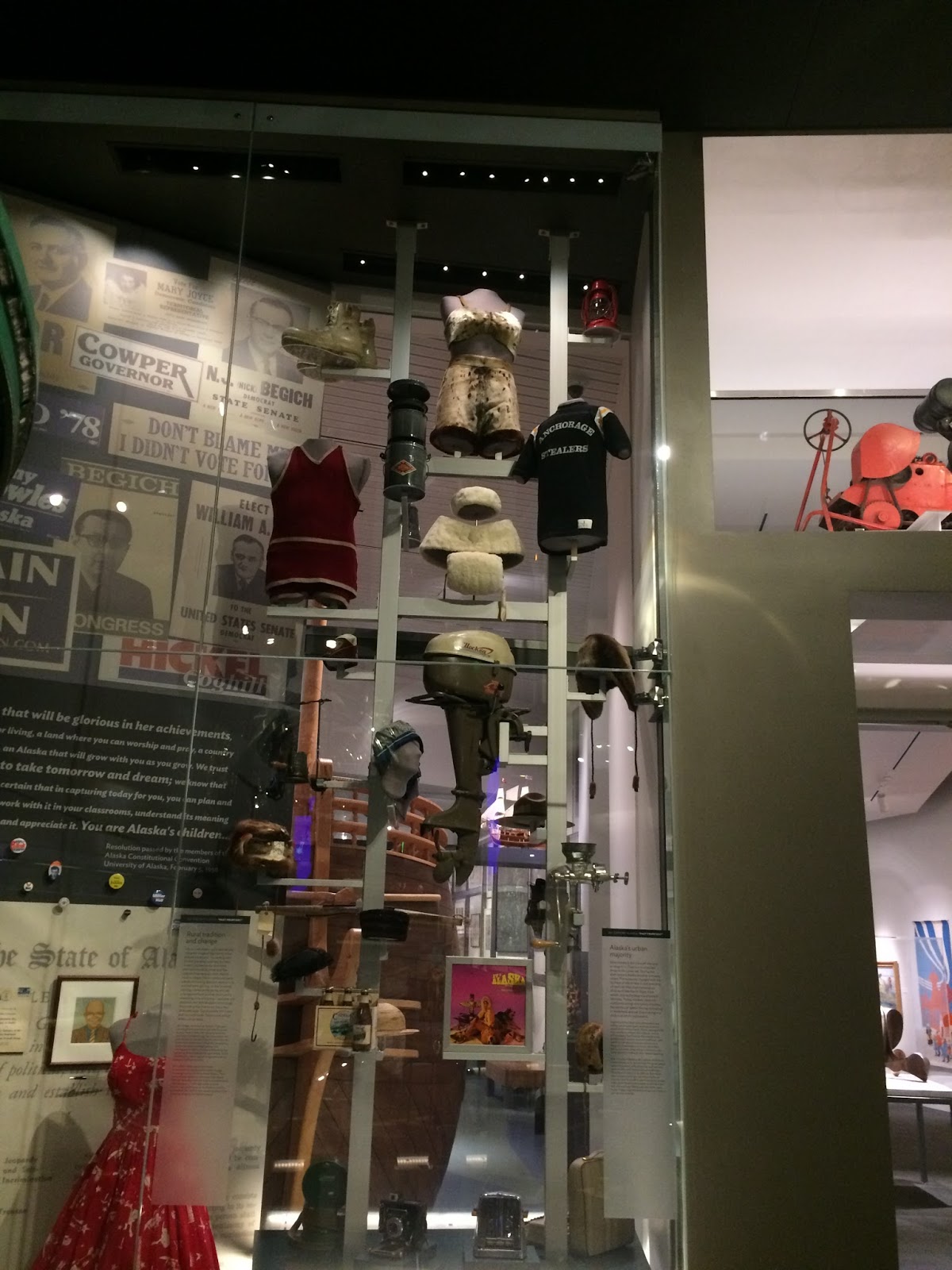 |
| The Anchorage Stealers mannequin was one of the few that needed finishing on the bottom, since it's suspended in the air. |
Silk caftan (ASM 94-39-1)
 |
| Mount-maker Jeff Thole works on the first stages of the mannequin for the caftan, presented to Mikhail Kuhkhan by Adolf Etolin. |
 |
| It's hard to believe that the trapezoid shape above became the mannequin for this silk caftan. The tricorner hat had extensive conservation work prior to exhibit. |
Chief Kaawa.ee's police uniform (ASM III-O-416)
 |
| Textile conservator Sarah Owens of the Anchorage Museum works with exhibits specialist Aaron Elmore (kneeling) and mount-maker Tanna Peters on the first fit of Chief Kaawa.ee's police uniform. |
 |
| This police uniform was one of several that required torsos and legs, a special challenge for the mount-making team! |
Child's parka (ASM II-A-3647)
 |
| Although the goal for most of the mannequins was a natural posture, some garments were uncooperative. The parka for this mannequin was tight in the shoulders, so the arms had to be sticking out to prevent strain on the garment. |
 |
| This was probably our smallest mannequin, and it looks even tinier in the exhibit in its sweet little swans' down parka. The parka was made in Siberia and traded to Alaskans. |
Reindeer parka (ASM II-A-4816)
 |
| A roomy parka like this one requires a very large mannequin to properly support it while on exhibit. |
 |
| Adding the head and arms helped fill out the folds in this reindeer parka once worn by territorial governor George Parks. |
Japanese uniform (ASM III-O-174 and III-O-175)
 |
| This mannequin for a Japanese World War II uniform (ASM III-O-174 and III-O-175) was one of the first ones we created. |
 |
| Our mannequin-making skills improved with practice! Although most visitors probably don't notice, this mannequin looks a little stiff. |
A multitude of mannequins!
 |
| Mannequin-makers at work in the Museum's collections processing room during the workshop. |
 |
| This World War II case shows the variety of uniforms worn by the US military in Alaska and also demonstrates the wide variety in mannequin shapes and sizes! |
 |
| Even heavy coats like these have fully finished mannequins inside to support their weight and make them look like they're being worn. |
We hope that everyone who helped out with the mannequins has had a chance to visit their creations and enjoyed this look back at the mannequin workshop!

Monday, April 10, 2017
Planning a visit to the APK State Library, Archives, and Museum
Summer is just around the corner, and if you're anything like me, you're dreaming about your summer travel plans! If Juneau is one of your of stops this summer, a visit to the new Father Andrew P. Kashevaroff State Library, Archives, and Museum should be on your to-do list.
How to get here:
The APK is located at 395 Whittier Street, a short walk from the cruise ship docks or an easy drive from the airport or ferry terminal. If you're coming from the docks furthest south, it's a straight shot along the waterfront. Thane Road becomes South Franklin Street, then Marine Way, then Egan Drive. You'll travel past City Hall, the blue Wharf building and the float plane hangar, Centennial Hall, and the Juneau Arts and Culture Center. Turn right at the traffic light onto Whittier Street and you'll see the Nimbus sculpture in our front plaza.
If you're coming from the airport, ferry terminal, or other points north, head south on Egan Drive towards downtown. There's only one highway in Juneau, so it's hard to miss. After you pass the Douglas Bridge, then take a left at the traffic light onto Whittier Street. The APK will be on your left, just past the KTOO radio station.
Where to park:
If you're in your own car, you can park in our underground parking garage off Whittier. One local called it the nicest garage in town, and visitors can park there for up to three hours while in the building. The gates go down when the building closes, but you'll still be able to get out if you're in the building. If you've left the facility and the building is closed, your car will be waiting for you when the gates open in the morning.
What's here:
You'll find the Alaska State Library on the second floor. There's free wi-fi and public computers to check your email or share photos on social media, and newspapers like the New York Times and periodicals like The Economist, Wired, or Time to help you get your news fix. If you want to do genealogy research or look at historic photos, you can visit the Historical Collections and Archives Research Center.
The Alaska State Museum's permanent exhibits were fully re-designed over the past four years and present a wide-angle view of the state's history, including Alaska Native cultures, the periods as a Russian colony and an American territory, and post-statehood. There are also displays about industry in Alaska, shipwrecks, World War II, a children's Discovery Room, and three temporary galleries with rotating exhibits. Find more info on the Alaska State Museum's web site.
The APK is home to Raven Cafe, run by the fantastic folks who operated Twilight Cafe over by the State Office Building. Their specialties include enormous adobo burritos, breakfast sandwiches, house made soups, refreshing fruit smoothies, and coffee and espresso drinks to keep you going. This summer, local literary maven Katrina Woolford will be running our gift store, which will have art, books, and other gifts for everyone at home. She plans to open for business by June 1.
When to come:
Summer hours begin in mid-May. The Alaska State Library, Historical Collections, and Archives are open Tuesdays through Fridays from 10:00 am to 4:00 pm and Mondays for research appointments. The Alaska State Museum will have transitional hours in early May, and 9:00 am-5:00 pm daily from mid-May through mid-September. Call (907) 465-2901 for the early May schedule.
Winter hours for the Alaska State Library, Historical Collections, and Archives are Tuesdays through Fridays from 10:00 am to 4:00 pm. Winter hours for the Alaska State Museum are Tuesdays through Saturdays, 10:00 am to 4:00 pm.
Hope to see you here at the APK this summer!
How to get here:
The APK is located at 395 Whittier Street, a short walk from the cruise ship docks or an easy drive from the airport or ferry terminal. If you're coming from the docks furthest south, it's a straight shot along the waterfront. Thane Road becomes South Franklin Street, then Marine Way, then Egan Drive. You'll travel past City Hall, the blue Wharf building and the float plane hangar, Centennial Hall, and the Juneau Arts and Culture Center. Turn right at the traffic light onto Whittier Street and you'll see the Nimbus sculpture in our front plaza.
 |
| This is the view of the APK State Library, Archives, and Museum that you'll see when you turn onto Whittier from Egan Drive. Photo by Lara Swimmer. |
If you're coming from the airport, ferry terminal, or other points north, head south on Egan Drive towards downtown. There's only one highway in Juneau, so it's hard to miss. After you pass the Douglas Bridge, then take a left at the traffic light onto Whittier Street. The APK will be on your left, just past the KTOO radio station.
Where to park:
If you're in your own car, you can park in our underground parking garage off Whittier. One local called it the nicest garage in town, and visitors can park there for up to three hours while in the building. The gates go down when the building closes, but you'll still be able to get out if you're in the building. If you've left the facility and the building is closed, your car will be waiting for you when the gates open in the morning.
 |
| Our parking garage is well-lit and provides easy access to the APK facility. The public entrance with stairs and elevator is in the far corner of this photo. |
What's here:
You'll find the Alaska State Library on the second floor. There's free wi-fi and public computers to check your email or share photos on social media, and newspapers like the New York Times and periodicals like The Economist, Wired, or Time to help you get your news fix. If you want to do genealogy research or look at historic photos, you can visit the Historical Collections and Archives Research Center.
 |
| Patrons in the Alaska State Library's Richard Foster Reading Room. It's a great place to relax, research, or keep in touch with folks back home. Photo by Lara Swimmer. |
The Alaska State Museum's permanent exhibits were fully re-designed over the past four years and present a wide-angle view of the state's history, including Alaska Native cultures, the periods as a Russian colony and an American territory, and post-statehood. There are also displays about industry in Alaska, shipwrecks, World War II, a children's Discovery Room, and three temporary galleries with rotating exhibits. Find more info on the Alaska State Museum's web site.
The APK is home to Raven Cafe, run by the fantastic folks who operated Twilight Cafe over by the State Office Building. Their specialties include enormous adobo burritos, breakfast sandwiches, house made soups, refreshing fruit smoothies, and coffee and espresso drinks to keep you going. This summer, local literary maven Katrina Woolford will be running our gift store, which will have art, books, and other gifts for everyone at home. She plans to open for business by June 1.
 |
| Raven Cafe is a popular spot for visitors, locals, and staff to grab coffee or lunch. The Cristobals are always cooking up new creations so their menu is never the same. Photo by Lara Swimmer. |
When to come:
Summer hours begin in mid-May. The Alaska State Library, Historical Collections, and Archives are open Tuesdays through Fridays from 10:00 am to 4:00 pm and Mondays for research appointments. The Alaska State Museum will have transitional hours in early May, and 9:00 am-5:00 pm daily from mid-May through mid-September. Call (907) 465-2901 for the early May schedule.
Winter hours for the Alaska State Library, Historical Collections, and Archives are Tuesdays through Fridays from 10:00 am to 4:00 pm. Winter hours for the Alaska State Museum are Tuesdays through Saturdays, 10:00 am to 4:00 pm.
Hope to see you here at the APK this summer!
Friday, March 3, 2017
Why can't I just call it SLAM?
Here at the Father Andrew P. Kashevaroff Alaska State Library, Archives, and Museum, we're having a bit of an identity crisis, in that nobody knows how to identify us. Since the early phases of our new facility project, the building has been called SLAM, an acronym of State Library, Archives, and Museum. I've always liked SLAM. It's easy to remember and fun to say. When I worked as a SLAM Project Assistant, I received an email that I had "the coolest job title ever."
Now that construction is finished and we have an official name, we've transitioned away from SLAM to the APK, an initialism of Andrew Petrovich Kashevaroff, our eponym. We usually have to add "formerly known as SLAM" for anyone to know where we're talking about, but we hope that it'll catch on with time. Father Kashevaroff was the first curator and librarian of the Alaska Territorial Library and Museum, which eventually evolved into the Alaska State Library, Archives, and Museum. He gave 20 years to this institution and laid the foundation for everything that we do. It's an honor to be part of his legacy. So if you're headed to our beautiful building, help us out and call it the APK.
Or, if you want to be official, you can go with the whole mouthful: The Father Andrew P. Kashevaroff Alaska State Library, Archives and Museum. And if you're unsure about how to pronounce it, you're not alone. Although Russian-speakers might cringe, we say it:

Now that construction is finished and we have an official name, we've transitioned away from SLAM to the APK, an initialism of Andrew Petrovich Kashevaroff, our eponym. We usually have to add "formerly known as SLAM" for anyone to know where we're talking about, but we hope that it'll catch on with time. Father Kashevaroff was the first curator and librarian of the Alaska Territorial Library and Museum, which eventually evolved into the Alaska State Library, Archives, and Museum. He gave 20 years to this institution and laid the foundation for everything that we do. It's an honor to be part of his legacy. So if you're headed to our beautiful building, help us out and call it the APK.
 |
| Studio portrait of Kashevaroff taken by Calvin Studio in Sitka, circa 1934. "The Very Reverend A.P. Kashevaroff, Curator and Librarian of the Alaska Territorial Museum and Library in Juneau." Alaska State Library Historical Collections, PCA 243-3-005. |
 |
| Father Kashevaroff and another man with a large spruce round in the Alaska Territorial Library and Museum. This object is currently on view in the timber section of the Alaska State Museum. Alaska State Library Historical Collections - PCA 243-3-008. |
Or, if you want to be official, you can go with the whole mouthful: The Father Andrew P. Kashevaroff Alaska State Library, Archives and Museum. And if you're unsure about how to pronounce it, you're not alone. Although Russian-speakers might cringe, we say it:

Friday, June 10, 2016
Public Art in the Andrew P. Kashevaroff State Library, Archives, and Museum
There's a lot to see at the Andrew P. Kashevaroff State Library, Archives, and Museum, including both familiar and brand new public art. Nimbus, newly repainted and brilliant green against the dark purple of the building, is glorious and unapologetic in the courtyard. Just inside the doors, the giant map of Alaska, Canada, and Russia inlaid into the terrazzo floor immediately grabs your attention, as does the towering eagle tree exhibit.
Walter Gordinier's cast glass pieces are interspersed throughout the interior of the building and outside on the grounds, which is just the way Gordinier likes it. "The art needs to move in concert with the structure, from out to in, from floor to wall, from seating to glass and back again," he writes in his artist statement. He created three interior pieces, Trilogy, the large glass columns in the front of the Library's Reading Room, Glacial Pond in the atrium, and Story Bars, which adorn the glass banisters along the second floor and the mezzanine. Outside, Gordinier's work is visible in Pivot Plaza and near the walkways. They accent the plaza and provide a backdrop for the outdoor venue, which will kick things off with dance parties every Friday this summer.
Many visitors have already enjoyed woodworker and former Juneauite Martin Shelton's contribution to the building, possibly without even realizing it. His Inside Passage benches are all different, just like the trees out of which they are made. "One of the things I strive for as an artist is to make my furniture both approachable and functional, this includes making it inviting both to the eye and the body," Shelton stated.
In the library area on the second floor, Ketchikan artist Evon Zerbetz's massive glass mural, We Are Written in the Layers of the Earth, provides a stunning dividing wall between the Richard Foster Reading Room and the Research Center. The mural features three human "mark makers" along with numerous Alaskan plants and animals. Zerbetz created the design using one-fifth sized linocuts, then worked with German company Derix Glasstudio to fabricate the piece and add the colors and textures.
All of the public art in the APK State Library, Archives, and Museum is meant to make our new space welcoming, comfortable, and enjoyable for our visitors. We are constantly finding new things to love about our building and we hope you will too.
The three installations featured in this post were selected by the the SLAM project Percent for Art advisory committee. Since the Percent for Art law was passed in 1975, Alaska has employed artists and benefited from the cultural, social, and economic value of public art. The program is overseen by the Alaska State Council on the Arts.
 |
| Nimbus, the sculpture people love to hate, returns to its place of honor in front of the building. |
Walter Gordinier's cast glass pieces are interspersed throughout the interior of the building and outside on the grounds, which is just the way Gordinier likes it. "The art needs to move in concert with the structure, from out to in, from floor to wall, from seating to glass and back again," he writes in his artist statement. He created three interior pieces, Trilogy, the large glass columns in the front of the Library's Reading Room, Glacial Pond in the atrium, and Story Bars, which adorn the glass banisters along the second floor and the mezzanine. Outside, Gordinier's work is visible in Pivot Plaza and near the walkways. They accent the plaza and provide a backdrop for the outdoor venue, which will kick things off with dance parties every Friday this summer.
 |
| The center pillar of Trilogy, back lit by the sun coming in the windows. |
 |
| Glacial Pond floats between the first and second floors. |
 |
| A close-up of Glacial Pond shows the different colors, textures, and layers. |
 |
| Each of the Story Bars is unique. Some let in lots of light and others are nearly opaque. |
 |
| A section of Pivot Plaza including Scrims, Passages, and one of the Axis Discs. |
Many visitors have already enjoyed woodworker and former Juneauite Martin Shelton's contribution to the building, possibly without even realizing it. His Inside Passage benches are all different, just like the trees out of which they are made. "One of the things I strive for as an artist is to make my furniture both approachable and functional, this includes making it inviting both to the eye and the body," Shelton stated.
 |
| Shelton's benches line the atrium, providing visitors with a place to enjoy the view and rest their legs. |
 |
| The benches incorporate the natural features of the wood, like this split that goes straight through the bench. |
 |
| From the Research Center, daylight from the windows along the front of the building makes the mural glow. |
 |
| On the Reading Room side, the images continue down onto the wood panels below. |
The three installations featured in this post were selected by the the SLAM project Percent for Art advisory committee. Since the Percent for Art law was passed in 1975, Alaska has employed artists and benefited from the cultural, social, and economic value of public art. The program is overseen by the Alaska State Council on the Arts.
Wednesday, May 18, 2016
Make summer plans with SLAM
Summer is just around the corner and that means fishing, camping, hiking, and traveling, but we've also got 10 ideas for great things to do with SLAM this summer.
10. Join us for the Grand Opening of the Father Andrew P. Kashevaroff State Library, Archives, and Museum on June 6, 2016. This community celebration is an opportunity for us to welcome Juneauites and visitors to the new facility, and we can't wait to share it with you.

9. If you just can't wait for June 6 or are looking for some VIP treatment, then get your tickets for the Friends of the State Library, Archives, and Museum special preview on Saturday, June 4, 5:30-8:30. There will be live music, delicious hors d'ouevres, and a no host bar, and a rare opportunity to go behind the scenes. Tickets are $75 for Friends members and $100 for non-members. For more information, visit the Friends website. Tickets are on sale now from JAHC and both locations of Hearthside Books.
8. Participate in summer reading at your local library. If you have young children, help prevent summer slide by reading, learning, and creating with free activities at the library. If you're child-free, many public libraries are now offering adult summer reading programs, where you can win great prizes, join book groups, and expand your reading interests.
7. Take a tour of the new permanent exhibits in the Alaska State Museum, on your own or guided by one of the Museum's volunteer docents. All the exhibits have been completely re-imagined, updated, and expanded with the help of community curators from around the state. You'll find artifacts that you've never seen before, as well as familiar favorites, and make new connections across cultures.
6. Come dance your heart out at a Rock Around the Block Party! Every Friday from June 10 through August 26, there will be live music and dancing on our Pivot Plaza next to Nimbus, and delicious eats at the food trucks on the JACC lawn from 5:00 to 7:30 pm.
5. Enjoy the summer's temporary show, "Living Alaska," a 10-year retrospective of contemporary artwork by Alaskan artists purchased by museums with funds from Rasmuson Foundation, on tour from the Anchorage Museum. Read the rave review in Alaska Dispatch News.
4. Research Alaskan history in the new, combined Historical Collections and Archives Research Center. For the first time, researchers can visit one location to delve into territorial records, historical photos, maps, and manuscripts.
3. Relax in the new Richard Foster Reading Room, where you can enjoy an unbeatable view, read an Alaskan newspaper or magazine, or study on your own. We'll have wi-fi, public computers, and plenty of outlets, where you can plug in, recharge, and relax.
2. Eat lunch in our atrium while observing the eagles in the new Eagle Tree exhibit, getting lost in Walter Gordinier's Glacial Ponding glasswork, or sitting on Martin Shelton's exquisite wood benches.
1. Brush up your Shakespeare during First Folio! The Book that Gave Us Shakespeare, on tour from the Folger Shakespeare Library. We are Alaska's host site for this national traveling exhibit, which will be on display from July 26 through August 24, and we'll have tons of great lectures, activities, and events for Shakespeare fans of all ages.
It's going to be a great summer! Hope to see you at SLAM.
10. Join us for the Grand Opening of the Father Andrew P. Kashevaroff State Library, Archives, and Museum on June 6, 2016. This community celebration is an opportunity for us to welcome Juneauites and visitors to the new facility, and we can't wait to share it with you.

9. If you just can't wait for June 6 or are looking for some VIP treatment, then get your tickets for the Friends of the State Library, Archives, and Museum special preview on Saturday, June 4, 5:30-8:30. There will be live music, delicious hors d'ouevres, and a no host bar, and a rare opportunity to go behind the scenes. Tickets are $75 for Friends members and $100 for non-members. For more information, visit the Friends website. Tickets are on sale now from JAHC and both locations of Hearthside Books.
 |
| The construction fence came down this week, so people can enjoy walking through the grounds. The Friends special preview will be the first chance to get inside. |
8. Participate in summer reading at your local library. If you have young children, help prevent summer slide by reading, learning, and creating with free activities at the library. If you're child-free, many public libraries are now offering adult summer reading programs, where you can win great prizes, join book groups, and expand your reading interests.
7. Take a tour of the new permanent exhibits in the Alaska State Museum, on your own or guided by one of the Museum's volunteer docents. All the exhibits have been completely re-imagined, updated, and expanded with the help of community curators from around the state. You'll find artifacts that you've never seen before, as well as familiar favorites, and make new connections across cultures.
6. Come dance your heart out at a Rock Around the Block Party! Every Friday from June 10 through August 26, there will be live music and dancing on our Pivot Plaza next to Nimbus, and delicious eats at the food trucks on the JACC lawn from 5:00 to 7:30 pm.
 |
| Image courtesy of the Juneau Arts and Humanities Council |
5. Enjoy the summer's temporary show, "Living Alaska," a 10-year retrospective of contemporary artwork by Alaskan artists purchased by museums with funds from Rasmuson Foundation, on tour from the Anchorage Museum. Read the rave review in Alaska Dispatch News.
4. Research Alaskan history in the new, combined Historical Collections and Archives Research Center. For the first time, researchers can visit one location to delve into territorial records, historical photos, maps, and manuscripts.
 |
| Looking for information about the Iditarod? You can read telegrams from the Archives, look at photos from the Historical Collections, or browse a 1925 newspaper on microfilm. |
3. Relax in the new Richard Foster Reading Room, where you can enjoy an unbeatable view, read an Alaskan newspaper or magazine, or study on your own. We'll have wi-fi, public computers, and plenty of outlets, where you can plug in, recharge, and relax.
 |
| One of the views from the Reading Room looks back on our old home in the State Office Building, but others look down the Channel, toward Mount Juneau, or over the Willoughby district. |
2. Eat lunch in our atrium while observing the eagles in the new Eagle Tree exhibit, getting lost in Walter Gordinier's Glacial Ponding glasswork, or sitting on Martin Shelton's exquisite wood benches.
1. Brush up your Shakespeare during First Folio! The Book that Gave Us Shakespeare, on tour from the Folger Shakespeare Library. We are Alaska's host site for this national traveling exhibit, which will be on display from July 26 through August 24, and we'll have tons of great lectures, activities, and events for Shakespeare fans of all ages.
 |
| An original First Folio of Shakespeare's works, printed in 1623, will be on display for four weeks in our new building. |
It's going to be a great summer! Hope to see you at SLAM.
Thursday, May 5, 2016
How to move a library: Books
The Alaska State Library is one of many Alaskan libraries that have moved to new digs in the past few years. To name a few, Sitka Public Library (formerly Kettleson), Cordova Library, Seward Community Library & Museum, Nome's Kegoayah Kozga Library, Talkeetna Library, and Juneau Public Library's Valley location all have new buildings.
We're fortunate that we're not moving very far. Our old and new locations are only a few blocks apart, but it's still too far to hand carry all the books or even for a book brigade, like this one used in Cordova. Video posted by Cordova Telephone Cooperative.
Every library move has different requirements and should use a moving method best suited to the collections, staff, and equipment of that library. Our collections move team, led by Public Services Librarian Katie Fearer, decided to move our book, periodical, and media collections on book carts. We already had more than 30 carts and were able to borrow six more from Juneau Public Libraries. The cart system allowed us to keep our materials on the shelves until the move actually started, which was important since we closed our doors on Friday, April 15, and started moving Monday, April 18.
Our staff and volunteers were split into three teams, one unshelving in the old building, one shelving in the new building, and one managing the traffic flow, which meant directing movers, operating the freight elevators, and communicating between the teams. This arrangement allowed staff to do all of the handling of books and other collections. Two movers wrapped the carts with pallet wrap, pushed the full carts from the old library into the truck and from the truck to the new Reading Room.
We did have a few mishaps, which informed us how to fine-tune our systems. A couple of times the books fell off a cart in transit, which meant that they had to be carefully reordered before going on the shelf. One small cart had a catastrophic caster failure where the wheel cracked in half. Two brand new carts ended up with bent casters, which will need to be replaced before they can be safely used again. But overall, we were thrilled with how well the process worked and were able to move our collections in half the time we originally scheduled.
We can't wait to show off our beautiful new Reading Room after the Father Andrew P. Kashevaroff State Library, Archives, and Museum opens on June 6. We hope to see you there, browsing an Alaskan newspaper, doing research from our microfilm, or just enjoying the view.
Finally, a huge thanks to Juneau Public Libraries for sharing their expertise, staff, and book carts with us! We're so lucky to have such a fantastic library community here in Juneau.
We're fortunate that we're not moving very far. Our old and new locations are only a few blocks apart, but it's still too far to hand carry all the books or even for a book brigade, like this one used in Cordova. Video posted by Cordova Telephone Cooperative.
Every library move has different requirements and should use a moving method best suited to the collections, staff, and equipment of that library. Our collections move team, led by Public Services Librarian Katie Fearer, decided to move our book, periodical, and media collections on book carts. We already had more than 30 carts and were able to borrow six more from Juneau Public Libraries. The cart system allowed us to keep our materials on the shelves until the move actually started, which was important since we closed our doors on Friday, April 15, and started moving Monday, April 18.
 |
| Full, wrapped carts waiting to be loaded onto the truck for transport to the new building. Photo by Ginny Jacobs. |
Our staff and volunteers were split into three teams, one unshelving in the old building, one shelving in the new building, and one managing the traffic flow, which meant directing movers, operating the freight elevators, and communicating between the teams. This arrangement allowed staff to do all of the handling of books and other collections. Two movers wrapped the carts with pallet wrap, pushed the full carts from the old library into the truck and from the truck to the new Reading Room.
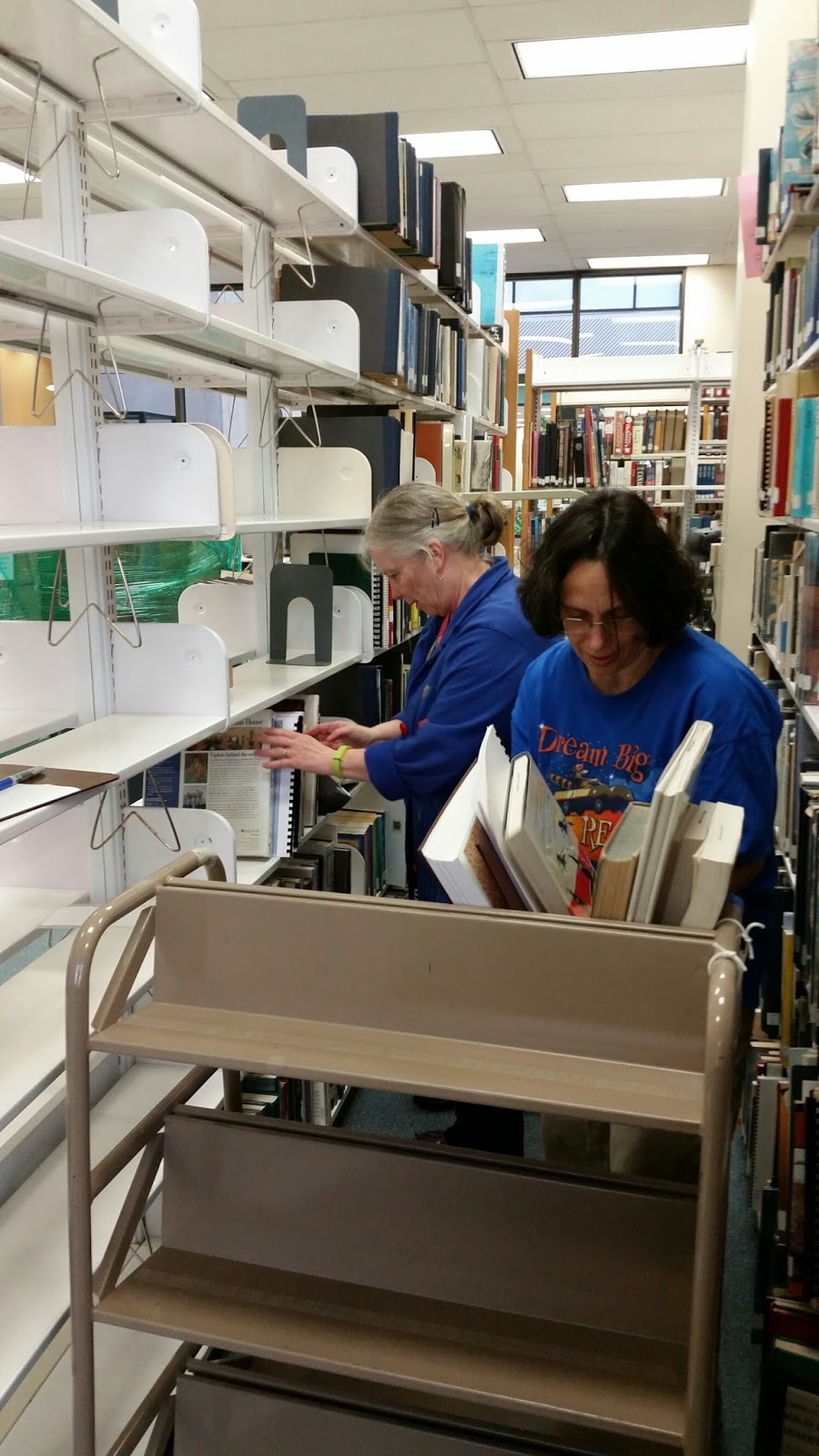 |
| State Librarian Linda Thibodeau and Library Assistant Ginny Jacobs unshelve books in the old building. Photo by Amy Carney. |
We did have a few mishaps, which informed us how to fine-tune our systems. A couple of times the books fell off a cart in transit, which meant that they had to be carefully reordered before going on the shelf. One small cart had a catastrophic caster failure where the wheel cracked in half. Two brand new carts ended up with bent casters, which will need to be replaced before they can be safely used again. But overall, we were thrilled with how well the process worked and were able to move our collections in half the time we originally scheduled.
 |
| According to the manufacturer, casters may be damaged, like this one, when moved over door thresholds with under heavy loads. These casters will be replaced before being used in the Library. |
We can't wait to show off our beautiful new Reading Room after the Father Andrew P. Kashevaroff State Library, Archives, and Museum opens on June 6. We hope to see you there, browsing an Alaskan newspaper, doing research from our microfilm, or just enjoying the view.
 |
| The view from our new home to our old one through one of many large windows in the Richard Foster Reading Room. |
Finally, a huge thanks to Juneau Public Libraries for sharing their expertise, staff, and book carts with us! We're so lucky to have such a fantastic library community here in Juneau.
Monday, April 11, 2016
Save the date for our grand opening, June 6, 2016!
The Father Andrew P. Kashevaroff State Library, Archives, and Museum will celebrate its grand opening on June 6, 2016. After years of planning, developing, and moving, we are so excited to reopen as an integrated facility in our beautiful new building.
June 6 is a significant day for us and for Alaska. On June 6, 1900, U.S. Congress passed the Alaska Bill or Alaska Civil Code, a massive piece of legislation that created a civil government for Alaska. The Alaska Bill became Chapter 786 of Session 1 of the 56th Congress. It created three judicial districts, based in Juneau, Saint Michaels, and Eagle City. It outlined the powers of the governor, which included everything from appointing the notary public to managing the sealing industry to leading the militia. It set taxes, moved the capital from Sitka to Juneau, and established the district historical library and museum.
The original district historical library and museum was funded by fees paid by lawyers admitted to the bar and by commission fees for notaries, which were both ten dollars. The library and museum was charged with collecting and maintaining "copies of all laws relating to the district, and all papers and periodicals published within the district, and such other matter of historical interest...The collection shall also embrace such curios relating to aborigines and the settlers as may be by the governor deemed of historical importance."
When Alaska became a territory in 1912, the district historical library and museum became the territorial library and museum, and eventually the Alaska State Historical Library and Alaska State Museum. The Information Services section of the Alaska State Library was added in 1955 to support research in the territory and the Alaska State Archives was created in 1970. All the entities joined together as the Division of Libraries, Archives, and Museums in 1991, and 2016 will be the first time that we will be together in one facility.
Please join us in celebrating the beginning of the next chapter for the Alaska State Library, Archives, and Museum. We look forward to seeing you on our 116th birthday, June 6, 2016!

 |
| SLAM pictured on April 7, 2016. Just two more months until we're open to the public! |
June 6 is a significant day for us and for Alaska. On June 6, 1900, U.S. Congress passed the Alaska Bill or Alaska Civil Code, a massive piece of legislation that created a civil government for Alaska. The Alaska Bill became Chapter 786 of Session 1 of the 56th Congress. It created three judicial districts, based in Juneau, Saint Michaels, and Eagle City. It outlined the powers of the governor, which included everything from appointing the notary public to managing the sealing industry to leading the militia. It set taxes, moved the capital from Sitka to Juneau, and established the district historical library and museum.
 |
| ALASKA BILL HAS PASSED. Daily Alaska Dispatch, June 12, 1900. |
The original district historical library and museum was funded by fees paid by lawyers admitted to the bar and by commission fees for notaries, which were both ten dollars. The library and museum was charged with collecting and maintaining "copies of all laws relating to the district, and all papers and periodicals published within the district, and such other matter of historical interest...The collection shall also embrace such curios relating to aborigines and the settlers as may be by the governor deemed of historical importance."
 |
| Father Andrew P. Kashevaroff was the first dedicated curator and librarian of the Alaska Historical Library and Museum. He was appointed by Governor Thomas Riggs and led the institution from 1919 until his death in 1940. Alaska State Library Historical Collections, PCA 243-3-007. |
Please join us in celebrating the beginning of the next chapter for the Alaska State Library, Archives, and Museum. We look forward to seeing you on our 116th birthday, June 6, 2016!

Friday, February 26, 2016
How to move a library: Microforms
Now that it's 2016, our move is just around the corner. The Alaska State Library's Information Services section will be the last of our Division to move into the Father Andrew P. Kashevaroff State Library, Archives, and Museum. The latest word is that we will start moving in mid-April, and the facility should be ready to open by mid-May.
Right now, we're preparing all of our microfilm and microfiche cabinets for refurbishing. We'll use them in the new building, but they need to be emptied so they can get cleaned, touched up, and painted. We will pack all the film and fiche in boxes and store them on pallets until moving time, so some of our microforms will be inaccessible for a few months. The Alaska newspaper microfilm, our most-used microform collection, will be the last packed and the first unpacked.
If the microfiche got out of order, it would be a major headache. To minimize the risk of a fiche-catastrophe, we ordered specially-sized boxes that fit one row of fiche. An additional benefit to this method is that one of these boxes is about as heavy as our staff would want to heft around. Each box is 6 inches tall and 6 inches wide, in three different lengths (16, 22, and 28 inches) to accommodate our varying cabinet sizes. Since fiche is about 5x6 inches, there's an inch of space at the top. That inch of air causes some concern that the boxes might crush during transport. We've arranged them like Lincoln Logs on the pallet for maximum stability, and will report back when we find out how it goes.
For microfilm, we are less concerned with interfiling, since the reels are in boxes. All of our cabinets are approximately the same length, so we ordered 28x12x6 inch boxes to accommodate three rows of microfilm. Although the drawers are five rows across, boxes for five rows would have been unwieldy and expensive. We've packed all of our federal and national newspaper microfilm, and it worked like a dream.
We purchased these boxes from ULINE, which has an impressive selection of sizes and shapes. All of the boxes we picked are top-loading, to make packing and unpacking easy. We considered modifying regular file boxes, like the AAA ones frequently used for moving offices, but found that it wouldn't save us money and would greatly slow down the packing process.
In other move news, we've selected locations for some of the notable features from our State Office Building location. The large relief map of Alaska that is hanging behind the Library's reference desk will be relocated to the OWL room in the new facility. The Rie Muñoz mural above the microfilm readers will move to the second floor atrium, near the Division's administration offices. Visitors will still be able to enjoy these favorites in their new home.
 |
| The APK building looking great on February 24, 2016. The only things missing from the front of the building are the doors, which are plywood. |
Right now, we're preparing all of our microfilm and microfiche cabinets for refurbishing. We'll use them in the new building, but they need to be emptied so they can get cleaned, touched up, and painted. We will pack all the film and fiche in boxes and store them on pallets until moving time, so some of our microforms will be inaccessible for a few months. The Alaska newspaper microfilm, our most-used microform collection, will be the last packed and the first unpacked.
 |
| Library assistant Ginny Jacobs transfers a row of microfiche from drawer to box. |
If the microfiche got out of order, it would be a major headache. To minimize the risk of a fiche-catastrophe, we ordered specially-sized boxes that fit one row of fiche. An additional benefit to this method is that one of these boxes is about as heavy as our staff would want to heft around. Each box is 6 inches tall and 6 inches wide, in three different lengths (16, 22, and 28 inches) to accommodate our varying cabinet sizes. Since fiche is about 5x6 inches, there's an inch of space at the top. That inch of air causes some concern that the boxes might crush during transport. We've arranged them like Lincoln Logs on the pallet for maximum stability, and will report back when we find out how it goes.
 |
| This pallet of microfiche is stacked, wrapped, labeled, and ready for moving. Although it looks like a small pallet-load, it is surprisingly heavy! |
For microfilm, we are less concerned with interfiling, since the reels are in boxes. All of our cabinets are approximately the same length, so we ordered 28x12x6 inch boxes to accommodate three rows of microfilm. Although the drawers are five rows across, boxes for five rows would have been unwieldy and expensive. We've packed all of our federal and national newspaper microfilm, and it worked like a dream.
We purchased these boxes from ULINE, which has an impressive selection of sizes and shapes. All of the boxes we picked are top-loading, to make packing and unpacking easy. We considered modifying regular file boxes, like the AAA ones frequently used for moving offices, but found that it wouldn't save us money and would greatly slow down the packing process.
In other move news, we've selected locations for some of the notable features from our State Office Building location. The large relief map of Alaska that is hanging behind the Library's reference desk will be relocated to the OWL room in the new facility. The Rie Muñoz mural above the microfilm readers will move to the second floor atrium, near the Division's administration offices. Visitors will still be able to enjoy these favorites in their new home.
 |
| This relief map has been popular with Library visitors for years. It will be on view in the new Library and will make a great backdrop for OWL videoconferences. |
Subscribe to:
Posts (Atom)
